Pied Beauty

Gerard Manley Hopkins (1844-1889)

Glory be to God for dappled things—
For skies of couple-colour as a brinded cow;
For rose-moles all in stipple upon trout that swim;
Fresh-firecoal chestnut-falls; finches' wings;
Landscape plotted and pieced—fold, fallow, and plough;
And all trades, their gear and tackle and trim.

All things counter, original, spare, strange;
Whatever is fickle, freckled (who knows how?)
With swift, slow; sweet, sour; adazzle, dim;
He fathers-forth whose beauty is past change:

Praise him.

Showing posts with label trees. Show all posts

Tuesday, November 23, 2010

Crape Myrtles Treat Us To Fall Color

Crape Myrtle leaf
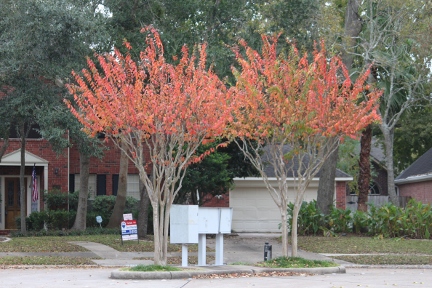
Last year, it seemed like the Bradford pear trees were unusually colorful.  This year, it's the crape myrtles.  All around my neighborhood, these lovely ornamental trees area covering themselves in shades of red and gold.  Most of them, that is.  My trees, 'Basham's Party Pink,' do not seem particularly lovely, perhaps when compared to the neighbors' trees.

Within yards of my nondescript trees.
I'm not sure what variety of crape myrtles are planted in our common areas.  They're a small to medium-statured tree with pinky-lilac flowers, perhaps 'Muskogee.'  They're all in various stages of fall coloration and it's beautiful, especially on days like this when it's overcast.

They have a lovely, smooth bark, too!
Crape myrtles were introduced (from Asia) in 1747, and are common throughout the southern US.  We like to say they are "the lilic of the South," but having lived in northern climes, I have to disagree.  Crape myrtles lack the scent, which seems to me to be the main thing about lilacs.  But their bloom season is very, very long -- almost all summer.

Happy fall!
And then, too, we occasionally get these wonderful autumn days when the crape myrtles form a blazing backdrop for a few bare branches.  Enjoy!

Tuesday, November 16, 2010

Tree Mutilation Time Again

I get it about the electrical lines.  I do.  It wasn't all that long ago that Hurricane Ike struck the Gulf Coast, leaving more than 2 million homes, apartments or businesses without electricity.  It took three weeks and more than half a billion dollars to restore power here.  Some of the trouble was caused by trees falling on or into power lines.  So I get it. But oh, my God!

Live Oak.
These trees have had their very hearts cut out.  I can't imagine how this is better than simply cutting them down in the first place.  The transmission line people say that their own foresters will determine whether it's better to trim a tree or cut it down.  I don't know what their criteria are, but I would bet that it has something to do with how much it costs to dispose of the tree and/or how much the tree owners complain.

An entire row of trees, all but destroyed.
And about those tree owners!  Sometimes the power lines are installed after the trees are already planted.  Sometimes trees grow up naturally under power lines and aren't cut down as seedlings by the mowers because they're sheltered by a fence line.  But sometimes, very large trees are planted directly underneath the power lines.  And some day, maybe not today and maybe not tomorrow, their hearts will be cut out or their heads will be cut off.

What's left?

The sight of these mutilated trees is enough to give you nightmares. 

At least they hire certified foresters!

Friday, November 12, 2010

Foliage Friday: Sacred Fig

Ficus religiosa at the San Antonio Botanical Garden
Aren't those leaves pretty?  This is Sacred Fig, or Ficus religiosa.  It's considered sacred by followers of Hinduism, Jainism and Buddhism.  Siddhartha Gautama was sitting under a Sacred Fig tree when he was enlightened. That tree was known as the Bodhi Tree and was destroyed in the second century B.C.

The Sri Maha Bodhi Tree.  Photo: N.Chamal, licensed under the Creative Commons Act.

A direct descendant of that original holy tree, the Bodhi Tree, still survives.  Known as the Sri Maha Bodhi, it was brought to Sri Lanka in 249 B.C. and is perhaps the oldest living angiosperm in the world. Certainly it is one of the world's great historical trees.  It serves as the parent for other Sacred Figs planted around the world.  Below is a Bodhi tree descendant, planted in the Foster Botanical Gardens in Hawaii.

Licensed under the Creative Commons Act.
These trees are native to India and prefer a tropical climate, but will tolerate life as a houseplant.  Treat as you would a Ficus benjamina.

Thursday, November 11, 2010

On Trees and Statistics

Did you see the publicity on the recent study, conducted in Portland, Oregon, that concluded that large street trees actually reduce crime?  Now I love trees.  But when I heard about this study, soon to be published in the journal Environment and Behavior, I felt a curmudgeonly skepticism rear its ugly head.

I love trees.  Even Bradford pears.
The study, performed by the US Forest Service, looked at several years of crime data, cross-referenced with aerial photographs, site visits and tax data.  In part because one of the authors lived there, the study was confined to a single police precinct area in Portland consisting mainly of single family homes.

I love trees.  Especially cedar elms.
Perhaps not surprisingly, the authors find that the presence of large trees is negatively correlated with crime.  Smaller trees, however, are positively correlated with crime.  Their conclusion?  Big trees prevent crime, while small trees cause crime.  I'm oversimplifying a tiny bit; the authors do explain in the final paragraph of a 29-page report that correlation is not causation, and that other variables are more strongly associated with crime and that unknown variables may have a large impact on crime prevention. 

I love Baldcypresses.
You wouldn't know that from reading the rest of the report, though.  Nor could you tell that from the press the study has received so far. For heaven's sake, don't put up burglar bars.  They're positively correlated with crime.  Make sure you have a tree that's at least 42 feet tall instead.

I love Weeping Yaupon.
I'm pretty sure that the large-tree factor is negatively correlated with crime.  I'm just not convinced trees are preventing the crime.  The same characteristics that cause people to care for trees is perhaps responsible for a (very slightly) lower crime rate.  How about, for starters, home ownership versus renting?  Income levels?  Education levels?  Previous history of crime? Economic conditions? Ethnic makeup?

I love conifers, too.
Oh well.  Perhaps I'm just experiencing a "Bah humbug!" moment.  May it soon pass!

You can read the entire study here.

Sunday, October 24, 2010

Fall Color: How We Do It Around Here

Most people know we don't get the spectacular fall foliage down here, but we do have some!  This is my young baldcypress tree, graciously turning a beautiful coppery color just in time for Halloween's festivities.  Baldcypress (Taxodium distichum) is a conifer, one of the few that isn't evergreen.  It's a big, big tree -- really too big for my small suburban lot.  One day, someone is going to regret that I planted it, but I couldn't resist.

Pick a bigger space if you plant one!
The baldcypress has fine, feathery leaves and round cones.  Unlike many trees, it thrives in heavy, clay soil.  For many of us southerners, it is a veritable symbol of the south, and is the state tree of Louisiana. Baldcypress sometimes sends up "knees," extensions of the root systems that poke up above the ground.  Even though mine is young, it's already sending up a few knees.  Eventually, I'll increase the size of the mulch circle around the tree until all the knees are inside.

Here's the fall color, just beginning...
In addition to the fall color it provides, baldcypress is also especially lovely in the spring.  The new leaves are the most wonderful shade of green -- a green you just won't see on an evergreen tree.  It always frustrates me when gardeners want to limit themselves to evergreens.  I love accompanying my baldcypress on its seasonal journey, from bright, chartreuse spring foliage, through the rich forest greens of summer, and finally to the amber leaves of fall.  After all the needles come down, I love to look at that trunk, straight as an arrow.  What I'd miss if I only planted evergreens!

Wonderful, fine texture
Baldcypresses are ancient and long-lived trees.  The oldest one in North American is rumored to be over 3,500 years old.  Some of the trees in its family include the true cypresses, cedars, junipers, dawn redwoods, and giant sequoias.

Thursday, October 21, 2010

Western Soapberry

Western Soapberry: berries turning golden brown
Now here's a native Texas tree, botanically related to the Golden Rain Tree, that provides good fall color and interesting gray bark.  As natural areas give way to housing and commercial developments, this pretty tree's continued survival in the wild is threatened.  It's a nice smaller-scale tree for urban environments and could be adapted to home and garden use.  If you're looking for a front-yard tree, think about Western Soapberry!

Western Soapberry: berries unripe.
Western Soapberry, or Sapindus saponaria var. drummondii, is a deciduous tree that ranges in height from 10 to 40 feet.  Soapberry flowers are white and usually appear in May or June, but far more striking are the golden berries of October.  These little fruits contain saponin and have been used as a soap substitute for quite some time.  Don't eat them, though -- they are toxic if ingested.

Bipinnate leaves of Western Soapberry
The variety name of Western Soapberry honors Thomas Drummond, a botanist, naturalist and explorer.  Mr. Drummond collected 750 plant species in Texas between 1833 and 1835, with particular focus on the area between Galveston Island and the Edwards Plateau.  If you're a Texan, you know this was a pretty untamed place back then!  Mr. Drummond died in Cuba on a plant collecting trip.  Many of our best-loved plants carry his name.

Here's more information about Texas History and the Western Soapberry.  Enjoy!

Saturday, October 2, 2010

A Visit To The Norfolk Botanical Garden

Last week, I was lucky enough to visit the Norfolk Botanical Garden in Norfolk, VA.  It rained the entire day and I was still so entranced with the gardens.  Perhaps the trees were my favorite part -- the Botanical Garden is home to 23 Virginia State Champion Trees, and even trees that weren't champions were still lovely.  I saw an old crabapple that must be magnificent in the spring.  The Flowering Arboretum alone spreads over 17 acres and is home to 336 different flowering trees.  The rain seemed to make the trunks of the crapemyrtles even more striking:  below is the trunk of 'Natchez' crapemyrtle, shining in the rain.

Crapemyrtle 'Natchez'
I loved the Japanese Garden too.  Dedicated in 1962, this garden was designed in the traditional hill-and-pond style.  The cloud-pruned hollies were striking and I loved the bonsai of the Elephant Bush (or portulacaria.)  Since I couldn't be there at dusk or dawn, perhaps a rainy, overcast day was perfect.  It's a very muted, peaceful place.

Portulacaria Bonsai
Just outside the Japanese Garden
Inside the Japanese Garden
The tropical display house was steamy and quiet -- it reminded me of the conservatory in an old movie.  It's where I saw the beautiful 3-foot-long specimen of Southern Maidenhair Fern.  No more need be said on that subject!  But I was also quite taken with the zebrina and various begonias.

Inside the Tropical House
I love to visit botanical gardens, especially when I'm unaccompanied by minor children.  Norfolk Botanical Gardens was a special treat and I only wish I had been able to spend more time there.

Saturday, September 18, 2010

A Good Pecan Harvest?

The pecans around here are gathering up their energies for the last push before harvest, which should start in most of Texas around the end of the month.  Will it be a good year?

Native pecans
It's hard to say.  Trees rely on plentiful water in August when they are filling out their nutmeats.  In my neighborhood, we were a bit shy on rainfall that month, though there was plenty in July and in September.  From down here on the ground, it looks like there are plenty of nuts in the trees.  That's always a good sign!

Pecans will drop their nuts when they are ready to be harvested, but you can pick them anytime the outer, greenish shuck starts to split.  The longer you wait, the wider the shucks split open, making it easy to shake out the hard, brown-shelled nuts.  Of course, the longer you wait, the more pecans the squirrels get to eat!

Pecans picked early in the season still have a lot of moisture in their nutmeat, and should be dried before eating.  You can dry them in the shell on screens or frames that allow air to circulate around them.  Keep them out of direct sunlight and away from heat.  You'll know they are ready when shelled pecans break in two with a sharp little snap! rather then bending. 

My pecans appear to have pecan nut scab, a disease I'm not really going to do anything about.  For one, I don't particularly care to eat pecans!  If the squirrels want them, they are welcome to all they can eat.  And it would be quite a pain to spray a large tree.  Growers combating this disease often spray up with fungicides up to 10 times per season.  It's not easy, growing pecans.

Friday, September 10, 2010

Foliage Friday: Sweet Gum Tree

Palmate leaves of the Sweet Gum tree
Is this tree disappearing?  I hope not.  It seems like they were everywhere when I was a kid.  I can't recall seeing one planted in someone's yard, not for the longest time.

The drawback:  immature fruit is already spiky!
The Sweet Gum Tree is native to the warmer sections of the United States and is one of our most common hardwood trees.  North of here, it's beloved for its vivid fall color, and noted for its spiny fruit.  You don't ever want to step on a dried sweet gum ball barefooted!  Yes, it's true that the fruits can litter your yard in the fall, and the limbs sometimes break in high wind, but it's a fast-growing shade tree with a pretty, distinctive leaf.  The five-fingered foliage is much more "pronounced" than that of the maple tree, if you know what I mean.

Bark -- see the tiny holes?

Birds of all kinds like the seeds contained in the mace-shaped fruit, but one bird goes out of his way to drink the golden sap:  the yellow-bellied sapsucker.  He drills neat rows of little holes and returns time and again to the same tree for nourishment.  Other creatures, once the hard work of drilling is done, are also attracted to the sap.  You may see butterflies, honeybees and hummingbirds drinking the sap of the sweet gum tree.  Of course, the sapsuckers will actively defend their dinner table!

Yellow-bellied Sapsucker.  Photo: Patrick Coin

I thought this was interesting:  the Sweet Gum tree was one of the first trees introduced to England from the New World.  Missionary and plant collector John Bannister brought it to England in 1681, where it was greatly admired for its fall color.  Before New World trees arrived, fall color was scarce indeed.

Friday, August 27, 2010

Foliage Friday: Arborvitae

All right, all right.  I promise after today, I'll try not to rave about foliage plants that might not do all that well here in good old hot, humid Houston.  But I think arborvitae is such a handsome plant!

Arborvitae at the Gardens at Ball
'Arborvitae' means 'Tree of Life,' so called because some specimens can live for centuries.  The aromatic leaves were also used for healing purposes.  They are often planted in cemeteries -- probably a good place for them.  They look best when left alone and don't tolerate pruning very well.  There are only five species in this genus: two are native to North America and three to Asia.  The North American native, Thuja occidentalis, was one of the first conifers imported into Europe, arriving on those shores sometime around 1536.

These plants are now known botanically as Thuja, but it's a relatively recent development.  I chuckled to read of the English distress when Linnaeus changed the name from "arborvitae" to "thuja" in 1737.  I'm afraid gardeners today get just as aggravated when botanists go around changing the name of plants.  We don't get used to things that fast!  I find I'm much more comfortable with arborvitae and it's been almost 300 years since the name was changed.

Tuesday, August 24, 2010

Quite A Storm Last Night!

It was a typical summertime thunderstorm: lightning, high winds, reports of hail.  At the worst of the storm, over 100,000 customers were without power.  As soon as it was over, we all went outside to inspect the damage, particularly to our trees.  My family was lucky -- all our trees were just fine.  Others were not so fortunate.  Trees were pushed over by the wind, sheared off at the top, and split down the middle. 

Pecan in ill health before the storm.

I noticed that all the neighbors seemed to know which trees were likely to be damaged in such a storm.  People knew what to look for, even if they didn't know the technical terms.  Leaning trees, rotting trees, trees with uneven canopies.

Didn't fall this time.
It's hard to remove a tree, especially a large one.  We come to regard them as members of the family.  And removing any tree can be expensive.  But sometimes, the tree really must go.  Not removing a problem tree can certainly cause problems later on!

Needs to come down pronto!
This tree didn't fall only because it is leaning on a neighboring tree.  Soil mounding like this indicates a problem with the root system.  This tree also had twig dieback, dead wood in the crown, and fewer leaves than you'd expect in mid-summer.


This tree is in jeopardy too.  Notice the roots exposed on the right side of the tree?  And how drastically it's leaning?  Luckily for the homeowner, it's leaning away from the house.

Split hackberry
Weak-wooded or fast-growing trees can sometimes fail without warning.  I don't know that there was much this homeowner could have done about this tree.

Sick old pecan

But the tree above had been failing for years.  It's an old pecan that had lost most of its major limbs.  The only green leaves on this tree can from water sprouts.  Earlier in the summer, the homeowner had a tree specialist remove much of the dead  wood.  For some reason, the tree trunk itself was preserved.  It was essentially a very tall pole, more than 40 feet tall.  A tree that had such obvious problems above the ground certainly has problems below ground, too.  You can see how the roots just failed in the storm.  And this was without a true crown or canopy to catch the wind.

Before
After

When we first bought our house, there was a fat old ash tree in the front yard.  It had an interesting shape and it did provide shade, but it was rotten to the core.  It was only being supported by the cambium layer, and an incomplete layer at that.  An accident waiting to happen!


On a side note:  I was astonished at how quickly my neighbors got out there and cleaned up their tree debris.  Even though the power did not return here until late, most of the tree limbs were neatly stacked on the curb this morning for the garbage collection.  Wow!
Friday, August 20, 2010

Foliage Friday: Colorado Blue Spruce

No, we can't really grow it in our area (humid zone 9a).  But it's the first thing I notice whenever I travel to cooler,drier climes.  Isn't it pretty?

Colorado Blue Spruce: Picea pungens

This beautiful evergreen looks best when left to form a pyramidal shape, with branches all the way to the ground.  It's a slow grower, but if left to its own devices, it can grow more than 50 feet tall.  The blue-green color is appealing, and the young cones are almost a violet-purple color. 

Why doesn't it work in the Houston area?  It suffers in our summer heat, and is prone to diseases like canker and insect damage from mites.  It does better in North Texas.  Which is why, probably, I really want one!

Thursday, August 5, 2010

Grafting. OMG!

One of our activities in the citriculture class last week was grafting.  My heart sank.

Grafting Knife.  Scary.

I don't like grafting.  I don't like the fiddly tools.  I can't see well enough to make a clean cut.  I get nervous in a room full of people with sharp knives and paraffin tape.  However, sometimes I can manage to rise to the occasion.

Rootstock.  Skinny.
My mission:  graft Everhard Navel Orange budwood to Poncirus trifoliata (Flying Dragon) rootstock.  We used a T-Budding technique, that involved both a vertical and a horizontal cut in the rootstock.  (Egads!)  Once those cuts were complete, we slid a slice of budwood up underneath the flaps of rootstock bark.  It's harder than it sounds.

Vertical Cut.  Gina's Steady Hands.
The rootstock was tiny and so were the buds.  I have no hope that it will work, but the graft is still green, not black, so I'm not giving up.  We're supposed to leave the graft alone for about 3 weeks.  If it works, the budwood should emerge right through the Buddy Tape.  We'll see about that!

Horizontal Cut.  Almost done!

If you make the vertical and horizontal cuts correctly, you'll form an upside-down T.  The wings of bark will curl up a little tiny bit, offering a spot to slide the budwood in, up underneath the loose or "slipping" bark.  Also, easier said than done.

Wrapping with Buddy Tape.  Needs 3 hands.
The Buddy Tape is waterproof, yet permeable.  Biodegradable yet strong enough to protect the wounded rootstock.  It can also be stretched up to 8 times its original length.  Sounds like witchcraft, doesn't it?

Complete.  At last!
And here it is, the completed little graft.  It will truly be a miracle if this works.  I'll let you know.