Pied Beauty

Gerard Manley Hopkins (1844-1889)

Glory be to God for dappled things—
For skies of couple-colour as a brinded cow;
For rose-moles all in stipple upon trout that swim;
Fresh-firecoal chestnut-falls; finches' wings;
Landscape plotted and pieced—fold, fallow, and plough;
And all trades, their gear and tackle and trim.

All things counter, original, spare, strange;
Whatever is fickle, freckled (who knows how?)
With swift, slow; sweet, sour; adazzle, dim;
He fathers-forth whose beauty is past change:

Praise him.

Showing posts with label weather. Show all posts

Monday, January 24, 2011

The Enormity of Water

I haven't written in a while, not because I've been indoors, but because I didn't think what I was doing was really related to gardening.  But it is, I think, in the most elemental sense.

I've been struggling with water.  The Papershell property (my garden center) is located on a very flat piece of ground near the floodplain of a creek.  All the land around here is very low and level -- it's basically all  Brazos River bottomlands.  It's very hard to drain land like that, unless money is no object.  Water tends to just sit on flat ground, and the clay is so impervious that it takes a long, long time for water to percolate down into the soil. 

Now factor in the rain patterns we get on the Gulf Coast.  Monsoon-style rain, followed by drought, followed by floods.  When it's dry, you can't really get a sense of the way the water will move across the land.  When it's wet, it's all submerged.  But from time to time, a window of opportunity opens up.  Now is one of those times.

Studying water in the bottomlands is a matter of inches.  You need to get right up close, muddy and wet.  The slightest rise or contour can divert water away from a catchbasin, or toward a structure.  To really see where the water wants to go, it's necessary to go out there when it's raining, which I hate to do.  To change where the water wants to go, it's necessary to dig.  And not just in clay.  In heavy, wet, sticky, clay.  That terrible sucking sound the mud makes as it yanks your boots off your feet? My nightmare.

Rubber Cowgirl Boots, the saving grace.
So yeah.  I've been out there.  Not gardening, exactly.  More like hand-to-hand combat.  Who's winning?  The elements, that's who.

Thursday, December 2, 2010

We Got A Freeze After All

Not a very hard freeze.  It was 30° at the Sugar Land airport when I got up at 5:30 Wednesday morning.  Which means it probably got to 30° in some unprotected parts of my garden too.  And a hard frost! I know it's a problem for gardeners, but I love the sparkle of the first hard frosts.  I took a drive before the frost had melted, but after the bright sun was shining.  Gorgeous!  Our version of winter beauty: bright, clear, dark blue sky (in the summer, the sky bleaches to almost white), golden grasses, sparkly frost, a few yellow leaves.  It's a stark beauty, one you have to get used to.  But I love it.

Ouch!  Tomato forest gets stung again.
In the garden, the tops of the tomato forest burned a bit more.  I don't think the plants will die, and I don't think it will harm the tomatoes.  I'm just waiting for a few to begin to ripen!  I think I'm almost there.  I'm keeping my fingers crossed we don't get a really terrible freeze before that happens.  On the other hand, I didn't cover them.  I'm resigned, either way.

Nasturtiums show only minor damage
The nasturtiums got a bit of a snap, too.  I don't know, really, whether the frost or dehydration got these leaves.  It was very windy Tuesday ahead of the cold front.  Extremely windy!

These are fine.
These too!
And these!
The lettuces don't notice light freezes and frosts, which made me wonder.  Why don't those tender looking leaves suffer in the cold and wind?  All the other plants I have with large leaves dehydrate so badly.  Where did lettuce originate, that it is so deceptively hardy?  I came across several answers: Egypt, Persia, Greece.  All relatively warm places.  So I ask you -- why does lettuce laugh at frost?

Snapdragons look like buttered popcorn!
And here is the reason I like to plant flowers in the vegetable garden.  It means I'm always successful! 

Tuesday, November 2, 2010

The Season Winds Down

Summer, that is.  November 1 as I write this, the nominal end of summer, if not the hurricane season.  And the garden looks like its holding on to the last few summer blooms, or resting up for the fall season.  Here's one last crinum that surprised me yesterday.  I thought they were all finished.

Summer's Last Crinum (probably!)
And the butterfly gingers continue to bloom, but slower now.  The fragrance is powerful, and reminiscent of gardenias.  If I were a hawk moth, I'd be there every night!

Wildly fragrant hedychium
Here are a few chrysanthemums, pale shadows of their cousins in garden centers now.  These are about four years old, and planted in an east-facing flowerbed.  When I planted them, they were dark lavender.  Now they've reverted to their true nature.  Which is sweet, small and not really worth it.  They are the last mums I ever bought.  I realized that I was constitutionally incapable of discarding them while there was the slightest evidence of life.  Henceforth, I'm cursed with these weak sisters who really should be removed and other, sturdier plants put in.  Live and learn.

Mums.  Ehh!
The bougainvilleas seem much happier, though, now that the hellish heat of summer has broken.  Even though we think of them as tropical bloomers, mine actually do much better in the spring and fall, when they can rest in the cooler, nighttime temperatures.  I can't quite capture the color of these flowers -- they are quite an unearthly shade of purple.  Mixed with that glowing morning glory of last week, they have an almost chemical aura.

Bougainvillea.  Intense!
And this little ornamental pepper, like the famous bunny, keeps going and going.  It either survived last winter or reseeded itself where it always does.  I like it for its perky colors and for the fact that I don't have to pick or pickle them!

Ornamental peppers.  No canning required!
 And finally, here is Valentine, who's also pricking up her ears a bit.  She likes the cooler temperatures too, but she's also celebrating the fact that I moved her to a sunnier location.  She's had a sunny fall, with no rain to speak of.  So, no blackspot!

Valentine.  Redder than Knockout and just as healthy!

Thursday, October 28, 2010

Greetings From The Tomato Forest

It wasn't supposed to be a tomato forest.  I had such high hopes: this time, I'll really stay on top of the pruning.  I need to take lessons from my friend Peg T., who's a ruthless pruner.  Her tomatoes, therefore, suffer less from disease and sunlight is able to reach all the leaves.   My tomatoes are aiming for the roof.  There are only four plants here, in a 5 foot by 5 foot space. 

See my optimistic little walkway? 
You know how it is.  At planting time, the tiny transplants look so adrift in the huge area allotted to them.  Each little plant sulked during the heat of August, under its tiny tomato cabana.  And now, they are reaching their green arms over the fence, wrestling with each other and with the fig ivy, breaking under the weight of their own leaves.

Sunchaser -- coming right along!
But so far, they look reasonably healthy.  The hardest thing about the fall garden is the fact that all the insect pests are awake, alive and well.  Sometimes we can get a head start on them in the spring, but not the fall.  And this August was much hotter than I expected (like this October!).  My plants have responded with lots of green growth, but not too much fruit set.  Actually, I'm surprised any set at all, considering how warm late October has been.  Yesterday and the day before both set records for heat: 90 and 91 degrees, respectively.

Sweet Million.  Too hot to set fruit.
The first one to set fruit was Sun Chaser, a disease-resistant hybrid that supposed to perform well in hot weather.  It has several good-sized green tomatoes on it now.  Carmello and Champion both have teeny, tiny tomatoes.  And little Sweet Million has lots of flowers, but so far, no fruit. 

Here's hoping for a cool front!

Tuesday, October 5, 2010

What's In The Fall Garden?

We've been enjoying fall weather that's so beautiful, so perfect, it's hard to even concentrate in the garden.  But Sunday, I got our little fall vegetable patch in order.  You remember those tomatoes I planted in August under their little cabanas?  Well, it was extra-hot until the very last few days of September.  So the tomatoes are tall and a bit on the leggy side.  But I do have flowers on them, so I am holding onto a happy thought:  fresh tomatoes for Thanksgiving!

Skinny devils, aren't they?
I planted two kinds of lettuce from seed: a Valentine mix of red and green, and another mix of mostly romaines.  I planted yellow bulbing onions and a mix of red and green salad scallions.  Greens do well here in the fall, so we picked out two cabbages and two kales, plus a square of "Pot of Gold" chard. 

Pot of Gold Chard, photo: Renee's Garden
Even though I never do well with carrots (because I can't/won't thin them properly), we did plant a cute little round carrot called "Round Romeo."  I had been saving space for broccoli and cauliflower, but we didn't find them!  My daughter picked out snapdragons and calendulas instead.  We squeezed them in amongst the vegetables.

Jack & Jill Sweet Peas, photo: Renee's Garden
Finally, we planted "Knee-High Jack and Jill" sweetpeas and "Whirlybird Rainbow Mix" nasturtiums on the low vegetable cages.  I like vegetable-gardening in the fall.  It just feels so much better to be outside now.  All around town, you can hear people breathing a sigh of relief.  We are all now sure we've made it through the worst of summer!

Monday, September 20, 2010

Them Old Cotton Fields

Crop is maturing...
All this rain can't be good for the cotton farmers.  It's about time to harvest -- most of the bolls are open and fluffy bits of cotton are lining the roads alongside cotton fields.  Cotton is harvested by machine nowadays, thank goodness, and has been for quite a while.  I can remember, though, being taught as a child how to pick it by hand.  I had accompanied a neighbor on a trip back home to Mississippi and Louisiana to help watch her babies while she got the crops in with her family.  Us bigger kids helped pick beans, but generally stayed away from the cotton fields.  One day, however, in the interest of our further education, we were all handed a tow sack as tall as we were and hustled out into the cotton.  My fingers prickle to this day when I remember trying to fill that bag with weightless white fluff.


Cotton has been cultivated in Southeast Texas since settlers of European descent first arrived, though the plant is native to Mexico.  It has a pretty flower, reminiscent of the hibiscus, mallow and okra, to which it is related.  The flower is creamy or pale yellow when it is newly opened and fades to a deep, rich pink.  It's odd to see both yellow and pink flowers on the same plant, but it happens all the time.

Cotton Boll Weevil Trap
Did you know that the cotton boll weevil, famous in song and story, is almost completely eradicated in the South?  Growers banded together to solve this problem, beginning in the late 1970s.  Each field is ringed with pheromone traps, which are monitored regularly.  When the traps indicate that the insects have reached a "trigger" population level, insecticides are applied to the fields.  Previously, farmers sprayed according to a timetable, regardless of insect population.  And the boll weevils are notoriously hard to control, since only the adults, outside the boll, are affected by insecticides.  You can always tell a cotton field, even when the plants are the tiniest seedlings, by the bright green traps hung on wooden stakes around the edges.

This cotton has been defoliated
Once the "bolls" or seed pods are mature, the cotton is normally defoliated to make harvesting easier.  In my neighborhood, some of the fields have been defoliated and some are still green.  It's hard to get the equipment into the fields when they are wet, but my guess is they will be harvesting very soon.

King Cotton

Wondering how organic cotton growers combat the boll weevil?  They piggyback on the success of conventional farmers in eradication zones:  if the conventional growers have eradicated a great number of boll weevils, it stands to reason they are less of a problem in organic fields.  They also use short-season cotton, hoping to get the crop in before weevil damage occurs.  There are a few natural predators of the boll weevil, but they are not readily available commercially.  Organic growers also use pheromone traps, and if weevils are discovered, they use pyrethrum as an insecticide and diatomaceous earth as a repellant.  As a last resort, the boll weevils are picked off the plants by hand.

Thursday, September 9, 2010

A Great Summer For Compost

It's a reach, I know.  But this was the only good thing about Houston summer weather that I could wholeheartedly affirm.
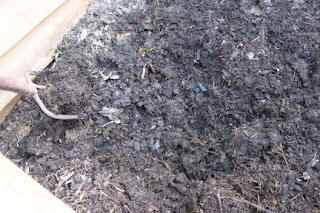
Looks pretty good, right?
It's been a wonderful summer for making compost.  The perfect conditions were present:  lots of hot, sunny weather, followed by lots of rain.  Down here in Fort Bend County, the rain came at the correct intervals and I never had to actually go out and water my compost.  I always feel silly doing that. 

I am a lazy cold composter, so I don't get very scientific about it.  Sometimes, if I'm feeling particularly energetic in the fall, I take the family on evening jaunts to gather leaves.  The Chief Engineer drives the van, my daughter keeps her head low so no one from school will recognize her, and I hop out and grab bags of leaves on the night before garbage day.  I like the clear plastic bags the best: that way I know exactly what I'm getting.  The idea is to alternate the dry brown leaves (carbon) with the lawn clippings (green).  I figure we cut the grass from about late February through October, so I try to get about 40 big bags.  Of course, then I have to stack them all behind the garage (but not against the garage!), which causes its own difficulties.

No leaves this summer.

My compost bin is built from a wonderful bracket set that I got from the Lee Valley catalog.  It can accommodate sides up to four feet long, but I will tell you -- that's too big.  I made some mistakes when I built mine, so you don't have to!  First, don't place it right up against the fence, especially not in a corner.  It's good to be able to get at it from all four sides.  Second, don't plan on making your bin 4 feet by 4 feet.  It's difficult to manage and difficult to fill entirely.  Make it 3 feet by 3 feet.  Third, don't cut your boards to fit exactly.  Make them as long as they can be without knocking into the boards on the adjoining sides.  When the bin is full, the compost presses outward, and boards cut too close will fall out of the slots.

My routine is simple:  I fill a metal bin in the kitchen with food wastes (plant material only).  When it's full, I dig a hole in the compost outside, stirring the big pile as best I can.  I bury the fresh trimmings.  In the summer, by the time the kitchen bin is full, the previous batch is already pretty far advanced.  I try to bury each batch in a different spot in the big pile. When I have leaves, I spread them in a layer just before I add that week's grass clippings. Because I am cold-composting, I don't put weeds in my bin, or any sort of animal products or oils.  We do get some critters in there, most notably the green fruit beetle, whose grub is big enough to have a license plate on it.  The wren family teaches insect retrieval classes out there too, but they are too cagey for me to photograph well.

Green Fruit Beetle.  Photo: Ron Hemberger

I usually stop adding vegetable wastes to the pile when the weather turns cool.  The compost sits quietly throughout our short winter and is ready for me to use each spring.  And no, I don't sift it.  It goes back to the garden as is.

Tuesday, August 24, 2010

Quite A Storm Last Night!

It was a typical summertime thunderstorm: lightning, high winds, reports of hail.  At the worst of the storm, over 100,000 customers were without power.  As soon as it was over, we all went outside to inspect the damage, particularly to our trees.  My family was lucky -- all our trees were just fine.  Others were not so fortunate.  Trees were pushed over by the wind, sheared off at the top, and split down the middle. 

Pecan in ill health before the storm.

I noticed that all the neighbors seemed to know which trees were likely to be damaged in such a storm.  People knew what to look for, even if they didn't know the technical terms.  Leaning trees, rotting trees, trees with uneven canopies.

Didn't fall this time.
It's hard to remove a tree, especially a large one.  We come to regard them as members of the family.  And removing any tree can be expensive.  But sometimes, the tree really must go.  Not removing a problem tree can certainly cause problems later on!

Needs to come down pronto!
This tree didn't fall only because it is leaning on a neighboring tree.  Soil mounding like this indicates a problem with the root system.  This tree also had twig dieback, dead wood in the crown, and fewer leaves than you'd expect in mid-summer.


This tree is in jeopardy too.  Notice the roots exposed on the right side of the tree?  And how drastically it's leaning?  Luckily for the homeowner, it's leaning away from the house.

Split hackberry
Weak-wooded or fast-growing trees can sometimes fail without warning.  I don't know that there was much this homeowner could have done about this tree.

Sick old pecan

But the tree above had been failing for years.  It's an old pecan that had lost most of its major limbs.  The only green leaves on this tree can from water sprouts.  Earlier in the summer, the homeowner had a tree specialist remove much of the dead  wood.  For some reason, the tree trunk itself was preserved.  It was essentially a very tall pole, more than 40 feet tall.  A tree that had such obvious problems above the ground certainly has problems below ground, too.  You can see how the roots just failed in the storm.  And this was without a true crown or canopy to catch the wind.

Before
After

When we first bought our house, there was a fat old ash tree in the front yard.  It had an interesting shape and it did provide shade, but it was rotten to the core.  It was only being supported by the cambium layer, and an incomplete layer at that.  An accident waiting to happen!


On a side note:  I was astonished at how quickly my neighbors got out there and cleaned up their tree debris.  Even though the power did not return here until late, most of the tree limbs were neatly stacked on the curb this morning for the garbage collection.  Wow!