Pied Beauty

Gerard Manley Hopkins (1844-1889)

Glory be to God for dappled things—
For skies of couple-colour as a brinded cow;
For rose-moles all in stipple upon trout that swim;
Fresh-firecoal chestnut-falls; finches' wings;
Landscape plotted and pieced—fold, fallow, and plough;
And all trades, their gear and tackle and trim.

All things counter, original, spare, strange;
Whatever is fickle, freckled (who knows how?)
With swift, slow; sweet, sour; adazzle, dim;
He fathers-forth whose beauty is past change:

Praise him.

Showing posts with label bugs. Show all posts

Friday, April 22, 2011

Ladybugs Make Me Uneasy

I just don't know about ladybugs.  I've heard a lot about them as natural predators and I guess Earth Day is as good a day as any to confess that I have deep misgivings about that.  I don't sell the cute little easy-to-merchandise bags at my garden center -- here's why:

Ladybug gives me the evil eye.
1. I don't think releasing clouds of ladybugs into your garden is an effective way to control soft-bodied insects like aphids.  Yes, I know.  Ladybugs are natural predators of aphids.   I've seen them with my own eyes, stalking aphids like cheetahs after (very slow) gazelles.  But I can't find any evidence that store-bought ladybugs area more effective than just doing nothing.  Want ladybugs to eat your aphids?  Stop spraying broad-spectrum insecticides and just wait awhile.  Native ladybugs will show up and eat until the populations are under control. 

Volunteer soldier in the aphid wars.
2.  I'm not okay with relocating huge populations of ladybugs from one part of the country to another.  Doesn't that seem ill-advised?  If it's not a good idea for red imported fire ants to move northward up the continent, how come it's a good idea for sweet little ladybugs to move south?  Ladybugs are harvested in great numbers from overwintering grounds, where they lie waiting docilely for the return of warm weather.  They're whisked out of the mountains in jet planes.  When they awaken from their slumber, they find themselves in red net bags at the checkout counter of your local garden center. That's if they are, in fact, native ladybugs.  There are reports of imported Asian ladybugs sold commercially as a green alternative to pesticides.

Maybe there's no harm in collecting, selling and releasing ladybugs.  But something about just doesn't seem right.  I'm all for maintaining populations of beneficial and predator insects.  I'd rather they be homegrown, that's all.

Thursday, March 10, 2011

Lovely Luna Moth

Once you get over the shock, it's quite a pleasure to watch a Luna Moth unfurl from its cocoon.  Even here in the wilds of the Texas Gulf Coast, a huge green moth is unusual.  The Luna, even more so, because it usually flies at night, in search of a mate.  It takes a few hours for the moth to take its final form.  When it first emerges from the cocoon, its wings are small, nothing at all like the 4" wingspan it eventually attains.

Almost done!

The adult Luna lives less than a week, and does not even eat, lacking a mouth.  It lives only to mate, and then passes on to its reward.  This moth hatched from a cocoon very near a sweetgum tree, a host plant for Luna larvae.  I'll keep my eye out for the next generation!

Long hindwings not yet unfolded...
Unfolded, but needs to dry a bit more

Tuesday, December 14, 2010

Green Stink Bug

It's December 14, and still not enough winter to slow down the Green Stink Bug.  This little rascal has many different host plants, and is always hanging around my garden somewhere.  And even though we've had two light freezes, he still soldiers on, sucking the life out of whatever plant he feeds on.  And they're prolific!  Each adult female produces on average over 250 eggs, though she completes her life cycle in as little as two months.

Green Stink Bug
Stink bugs have piercing mouthparts and damage plants by sucking juices from young tender growth and developing fruit.  They always seem to have an eye out for my tomatoes, and I struggle to control them in the spring.  You'd think by now, when we're covering the ripening tomatoes against early frosts and freezes, that the stink bugs would be overwintering elsewhere, but here they still are.  As ever.  Yuck.

By the way, the best control I've found is just to squash them, stink and all.  I've not had good success with organic methods.  I think they're tougher than I am!

Tuesday, October 19, 2010

Bug With Poise

I wish I could convey the gravity possessed by this bug.  He's not naturally shiny like that:  he arose from the sweet potato patch as I was watering one evening.  If you were there to watch closely, you might have seen him almost shake off the water.

Leaffooted Bug, I believe...
He had a measured and stately gait; ascending to the top of a nearby dwarf yaupon took him at least 5 minutes. I think he knew I was there, trying to catch him in the light with the proper camera lens.  He favored me with a slow glance over his shoulder as if to say, "Yes?"  But very slowly.  And with a very un-bug-like hauteur that is most uncommon in my little vegetable garden.

Photo: Tom Barrow
I stepped back and let him continue his sunset gaze.

Sunday, October 17, 2010

Ragweed or Goldenrod?

I can tell fall is coming after all, because I spend my days tanked up on Zyrtec and Sudafed and my nights dreaming Benadryl dreams.  I don't know how the pollen count is where you live, but it's terrible here.  Ragweed is our main culprit, sending the pollen counts skyrocketing for almost a month now.  But the goldenrod's blooming now too, so we're being warned not to blame goldenrod.  It's not the goldenrod's fault, just because it looks like ragweed.

Bad guy or good guy?
I doubted my ability to tell one from the other.  And I couldn't let it go, because I kept driving past fields and fields of bright yellow flowers, which were probably goldenrod (right?), but could be ragweed.  I looked at pictures on the internet.  I looked at my handy weed field guide.  Informative, but still, I was unable to identify those weeds blooming their heads off in our area fields.  I dreaded walking through it, in case it was ragweed, but I had to find out.

Goldenrod?
I think it's goldenrod, all right, Solidago canadensis.  The leaves are lanceolate and the plants are taller than ragweed usually is.  Except for that giant ragweed.  Did you know there was a giant ragweed?  Time for a closer look...

Leaves like goldenrod and brightly colored...
Yep.  Looks like goldenrod.  These plants don't seem to have the reddish stem of ragweed, and the flower heads lean over and downward.  I seem to remember that ragweed holds its flower heads straight up.  Probably safe to venture closer.  Oh no!  Some have flowerheads standing straight up!

Young goldenrod or mature ragweed?
And here's something else.  Is this a goldenrod plant that's just beginning to flower?  Or could it be ragweed? 
Now that I'm home, I can't remember if this plant had the raggy leaves or the nice, neat, narrow leaves.

Goldenrod!
Ah, now I feel better!  Ragweed is wind-pollinated, which is why it has to release those billions of pollen grains every year.  Goldenrod is pollinated by sweet little honeybees, because their pollen grains are too heavy to be carried by the wind.  (Of course, bees also visit ragweed for the pollen, but I'm hoping for the best!)

Thursday, September 23, 2010

The Sounds of Summer

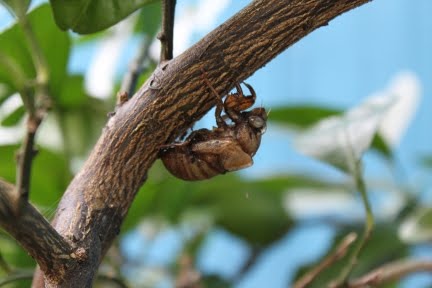
The song of the cicada is the constant backdrop to our lives in the summer.  After a while, you don't really even notice the drone that rises, then falls, throughout the day and early evening.  Cicadas are native to temperate and tropical areas, and ours really kick it into high gear in July, August and September.  They shed their old skins as they molt, leaving behind a startling reminder of how big they really are.

Empty shell, discarded by occupant.

When I was growing up, we referred to them (incorrectly) as locusts, and it took me a long time to learn to call them cicadas, but cicadas they are.  These big insects have life spans that range from 2 to 5 years, although some periodic cicadas live for up to 17 years!  Although they do feed on plants, they're not really considered pests, unless you happen to place the empty shell on your sister.

I remember as a young adult attending a meeting in Leesburg, Virginia in August.  They have cicadas there too.  Our group took a walk around a little nature trail one evening, much to the shock and horror of one of our European companions.  He couldn't figure out what that terrible noise was, and why we southerners couldn't hear it.  It took him a good 10 minutes to explain to us what he was hearing before we figured it out.  Only cicadas!  Not dangerous!  I don't think he believed us, though.

Here's a link to Soundbible's Cicada clip, so you can hear it for yourself.

Thursday, September 9, 2010

A Great Summer For Compost

It's a reach, I know.  But this was the only good thing about Houston summer weather that I could wholeheartedly affirm.
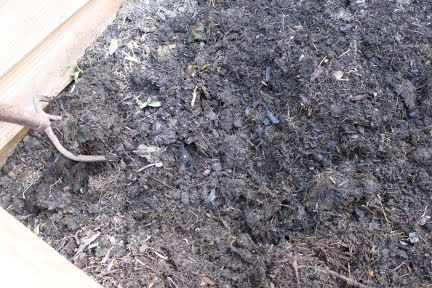
Looks pretty good, right?
It's been a wonderful summer for making compost.  The perfect conditions were present:  lots of hot, sunny weather, followed by lots of rain.  Down here in Fort Bend County, the rain came at the correct intervals and I never had to actually go out and water my compost.  I always feel silly doing that. 

I am a lazy cold composter, so I don't get very scientific about it.  Sometimes, if I'm feeling particularly energetic in the fall, I take the family on evening jaunts to gather leaves.  The Chief Engineer drives the van, my daughter keeps her head low so no one from school will recognize her, and I hop out and grab bags of leaves on the night before garbage day.  I like the clear plastic bags the best: that way I know exactly what I'm getting.  The idea is to alternate the dry brown leaves (carbon) with the lawn clippings (green).  I figure we cut the grass from about late February through October, so I try to get about 40 big bags.  Of course, then I have to stack them all behind the garage (but not against the garage!), which causes its own difficulties.

No leaves this summer.

My compost bin is built from a wonderful bracket set that I got from the Lee Valley catalog.  It can accommodate sides up to four feet long, but I will tell you -- that's too big.  I made some mistakes when I built mine, so you don't have to!  First, don't place it right up against the fence, especially not in a corner.  It's good to be able to get at it from all four sides.  Second, don't plan on making your bin 4 feet by 4 feet.  It's difficult to manage and difficult to fill entirely.  Make it 3 feet by 3 feet.  Third, don't cut your boards to fit exactly.  Make them as long as they can be without knocking into the boards on the adjoining sides.  When the bin is full, the compost presses outward, and boards cut too close will fall out of the slots.

My routine is simple:  I fill a metal bin in the kitchen with food wastes (plant material only).  When it's full, I dig a hole in the compost outside, stirring the big pile as best I can.  I bury the fresh trimmings.  In the summer, by the time the kitchen bin is full, the previous batch is already pretty far advanced.  I try to bury each batch in a different spot in the big pile. When I have leaves, I spread them in a layer just before I add that week's grass clippings. Because I am cold-composting, I don't put weeds in my bin, or any sort of animal products or oils.  We do get some critters in there, most notably the green fruit beetle, whose grub is big enough to have a license plate on it.  The wren family teaches insect retrieval classes out there too, but they are too cagey for me to photograph well.

Green Fruit Beetle.  Photo: Ron Hemberger

I usually stop adding vegetable wastes to the pile when the weather turns cool.  The compost sits quietly throughout our short winter and is ready for me to use each spring.  And no, I don't sift it.  It goes back to the garden as is.

Tuesday, August 3, 2010

Catfacing on Pears

Pears in Texas are commonly harvested in August, and it looks like it's been a good year, for the most part.  The winter weather we had ensured that most of our trees got enough chill hours to flower well, and we haven't had to endure the droughts of last year.  I've seen some great looking pears, but also some with catfacing.

Catfacing Damage on Pears

What causes this kind of fruit deformation?  Sucking insects, such as leaffooted bugs, boxelder bugs, stink bugs and lygus bugs.  These insects feed on the surface of the developing fruit, killing cells.  As the fruit matures, it dimples into what someone must have thought looked like a cat's face.  By the time you see this level of damage, it's too late to treat the cause.  Most of these insects migrate in from nearby fields or fly up from debris on the orchard floor.  Normally, this is only a sporadic problem.  You may not have it every year or you may only have the problem on a few of your trees.  Monitor closely early and late in the season, during pre-bloom through early fruit development and again in late summer or early fall.  Look for the adults and nymphs who are feeding on developing or mature fruit. 

 (Leaffooted Plant Bug, Adult and Nymph)

To control them, watch for groundcovers that harbor overwintering adults.  Limit overuse of insecticidal sprays (organic or conventional) that may harm natural predators.  As a last resort, use an insecticidal spray in the spring just as adults emerge from hibernation, usually around petal-fall.  Don't apply unless the problem is severe: these insects rapidly build up resistance and the sprays do harm natural predators.  For that reason, spot treatment is better than spraying everything in sight.  Don't spray during bloom: all listed products are toxic to pollinators. 

One of several Lygus bug species.  Photo by Scott Bauer, USDA

Thursday, July 29, 2010

Grasshopper Nymphs?

Maybe that's what these are.  I'm not exactly sure.  There are a few on each of my three citrus plants.  If they are young grasshoppers, I should really pick them off.  Technically, they're a pest.  They do eat foliage.  I see some foliage damage.  But...


They're so interesting, so outlandish when viewed from close up, that I think I'll just watch them for awhile.


Today and tomorrow, I'm at an AgriLife Extension Citrus Specialist training.  If they're not grasshopper nymphs, I should be able to find out what they are.  I'm also hoping to get some good pictures!

Note:  My friend Victor advises me that these are juvenile katydids, members of the longhorned grasshopper family.  Their bodies widen considerably as they grow older.  Does that sound familiar?

Monday, July 26, 2010

Alas! Cucumbers Succumb To Bacterial Wilt


Bacterial Wilt is a serious problem for all cucumbers and squash-type plants.  It's spread by insects -- in this case, by the cucumber beetle.  Once Bacterial Wilt takes hold, things happen quickly.  I first noticed wilting of leaves when the plants had plenty of water.  All the leaves on a lateral stem wilted, followed by the entire vine. Some of the cucumbers were deformed and some of the later ones were bitter-tasting.


Like many plant diseases, there isn't much you can do to help plants that are already infected.  It's best to pull out all sickly vines and destroy them.  I'm not composting, in case stray cucumber beetles are lurking in the foliage that's not quite dead yet.  To prevent the disease, you have to control the cucumber beetle, and that's not easy, particularly for organic gardeners.

 (Photo: Pollinator via Wikimedia Commons)

These beetles are small, only about a quarter-inch long, and move quickly.  You can try floating row cover, but it must be removed for several hours a day to allow the flowers to be pollinated.  Contact insecticides will work, but must be applied frequently and can be toxic to pollinators.  I usually just call it a day when the Wilt strikes -- and we had a pretty good cucumber harvest this year. 

Next season, I will rotate my crops so I don't plant cucumbers in the same spot.  Maybe that will help!

Tuesday, July 20, 2010

At the Cockrell Butterfly Center

Waiting on the vaunted Corpse Flower (Amorphophallus titanum) to bloom.  Nothing yet, but the horticulturists are getting out the big guns: rotting bananas.  Perhaps the ethylene will cause Lois to finally burst into stinky flower!  Until then, there's the butterflies:


(Butterflies with numbers on the wing are part of a study.  A steady-handed researcher writes the numbers just before releasing them into the garden.)

Tuesday, July 13, 2010

Butterfly Gingers


or Hedychium coronarium, a reliable standby in the Houston garden.  These lovely gingers seem to tolerate a wide range of exposures, from full shade to almost full sun. Last year's freezes killed them to the ground, but they grew back again from the roots, and much more quickly than the variegated gingers did.  They are vigorous, and clumps can spread rapidly, but they form a nice tropical thicket in the right location.  I have mine planted on the downhill side of a gentle slope.  The dense canes slow the rainwater runoff and they love the water.  I don't know if it's possible to overwater them!

(I wish I could capture the fragrance in a photo!)

Butterfly gingers have beautiful flowers too, which are strongly scented.  To me, they smell like gardenias.  The white flowers and powerful fragrance are signals for night pollinators -- in this case, the beautiful hawkmoth.  These large moths are as big as hummingbirds, and can sip nectar without perching on the ginger flowers.  They can be quite an eerie surprise when you're in the garden at night!


(Photo: Umbergo Salvagnin via Wikimedia Commons)