Pied Beauty

Gerard Manley Hopkins (1844-1889)

Glory be to God for dappled things—
For skies of couple-colour as a brinded cow;
For rose-moles all in stipple upon trout that swim;
Fresh-firecoal chestnut-falls; finches' wings;
Landscape plotted and pieced—fold, fallow, and plough;
And all trades, their gear and tackle and trim.

All things counter, original, spare, strange;
Whatever is fickle, freckled (who knows how?)
With swift, slow; sweet, sour; adazzle, dim;
He fathers-forth whose beauty is past change:

Praise him.

Showing posts with label plants. Show all posts

Sunday, June 26, 2011

Absence Makes The Heart Grow Fonder

In the garden, at least!  Of course, I like everything I've planted in my garden, but the ones I really love are the ones that pop up and surprise me.

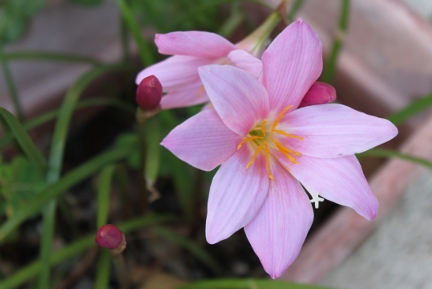
Zephyranthes or Rain Lily

Since we got an inch or two of much-needed rain last week, the rain lilies are blooming all over the garden.  I adore these little bulbs, and all the more, I think, because they aren't always there.  I love how they bloom so reliably in the summer, but on their own timetable.  They have an orrnery sense of self-possession, blooming after it rains but not after you water them.

Mostly pink but sometimes apricot, white, or yellow.

There are perfectly nice plants that bloom all summer here in Sugar Land, and quite a few of them are planted in my garden.  But perhaps because they are always in flower, I just don't LOVE them the way I love rain lilies.  And it's not that they're exotic or strange: rain lilies are quite common and even grow wild around here.  I imagine it's the way these intermittent bloomers add surprise and change to the garden.

Containers or flowerbeds, sun or mostly sun.

Don't knock it -- there's something to be said for the sense of wonder that we might not get from a begonia.

Friday, April 1, 2011

And The Garden Falls Beautifully Into Disrepair


I love how lettuce looks good even when you completely ignore it for weeks at a time.  And how the purple oxalis creeps in to offer such a nice purple contrast.

Thursday, March 3, 2011

The Plant That Assigns Chores

I have a lovely little cherry bush that wants me to paint the garage.  The first few years I had it, it was a shy, unassuming little thing.  Made no demands.  Grew slowly but steadily.  Bloomed sporadically the first spring but very nicely thereafter. 

Hirome, a dwarf flowering cherry

The bossy behavior started last year, when the cherry was at its peak.  "Paint the garage!" it insisted.  The argument was that the beautiful light pink blossoms were lost against the dull beige of the garage siding.  The cherry advocated for a dark forest green, but that annoyed the spider lily, whose strap-like foliage is that very same color.  I viewed slate gray as a compromise color, but nothing was accomplished last year.

The complainant, stomping its feet on the leucojum.

This year, the cherry is adamant.  Either I paint the garage to show off the pink spring finery or else!  Or else what, I do not know.  I hate to think what a vengeful shrub can do -- I've witnessed the wrath of Climbing Old Blush, so I'm a believer!


The cherry is "Hirome," or "Hiromi," a Prunus jacquemontii dwarf flowering cherry that is extremely well suited to the hot, humid south.  I have mine planted on the east side of the offensive garage, where it gets morning sun.  I don't do anything at all to it -- no pruning, fertilizing, spraying, and very little additional water now that it's established.  It's about 5 feet tall, and a great favorite of the mockingbirds when the fruits (gumball-sized) come in.

Thursday, February 17, 2011

The Newest Thing Is Old Hat

Wednesday I had the great good fortune to attend a seminar at Spring Creek Growers, presented in part by Ball Horticultural Company.  The idea is introduce garden center folks and landscape contractors to the newest, most innovative "plant material" out there, in the hopes that we can entice our own customers to buy them.  (That's what they call it sometimes, plant material.  Isn't that a little, well, dreary?) 

'Phantom' Petunia
I love these events.  I love to hear about all the research and development that goes into the creation of a "new" plant.  I get all plant-geeky inside, just hearing words like vegetative or triploid.  And the facility at Spring Creek is very, very nice, and the food was delicious, and it makes for a great start for the spring season.

'Breathless' Euphorbia
What thrills me about springtime, though, does not necessarily thrill the customers.  The panel discussion pointed up a disconnect between what the Ball folks were promoting, and what the landscape contractors, re-wholesalers and garden center owners were looking for.  The Ball representative started the discussion by asking each of the participants how they felt about new plants, new innovations, new products.  You could tell he was very excited about Ball's product line, and he was right to be -- there are some very interesting new plants on the market.  However...

Zinnia 'Zahara Double Duo'
One by one, the panel participants said, in not so many words, that simply being "new" was not good enough.  The landscape contractor said that her clients never come to her, asking for the newest thing.  They rely on her to put together a plan that works for them, in their budget.  She believed it was important for her to find out about new plants, but the customer wasn't driving that.  The garden center owner said that a few of her customers came into the store looking for the latest in new plants, but that only happened if there were a big national marketing push behind the product.  She also said that much of the time, the new products failed to deliver on the promises made by these marketing campaigns.  The Wave petunias are a good example -- they don't perform here nearly as well as promised here, in our climate, as other petunias might.  The rewholesaler, who provides plants primarily to landscapers, said that he had to push the new products -- there wasn't a demand from his clients specifically for the newest varieties.

Coleus 'Redhead'
The discussions went on in this vein for about half an hour.  None of the panelists were using social media or traditional advertising to promote new products.  None of the panelists felt that "newness" provided a higher price point or profit margin.  In fact, while there was excitement about specific plants, I thought I detected a general skepticism about "newness" in general.  Simply being new doesn't mean a plant can solve a customer's problem or meet a customer's need.  It's hard to say what was going through the Ball rep's mind -- he put up a good front.  But it's got to be discouraging to have your customers tell you new's not where it's at.

Verbena 'Aztec'
I'll put my customer hat on for a minute.  Would I rather have a new petunia, in the rare and unusual shade of black?  Or would I rather just have a petunia that can make it longer through the heat and humidity of our summers?  I appreciate what Ball's doing here and I love some of the new plants.  But I hope they don't overestimate the importance of new and different.  I think many of us would be satisfied with a good quality, virus-free same-old, same-old.


All photos courtesy Ball Horticultural Company, and a big thanks to Spring Creek Growers for hosting us.  It was a very interesting, thought-provoking event!

Thursday, January 27, 2011

Iceland Poppies

Did you forget to plant your Iceland Poppies last fall?  It's not too late!  Although these dainty beauties dislike our warm weather, they should be able to hold on through the end of April or so.

Papaver nudicaule 'Champagne Bubbles'
I love this variety -- "Champagne Bubbles."  The flowers come in an array of warm, sunny colors like red, yellow and orange.  I think the petals look like the finest silk crepe, and yet they are fairly tough.  Iceland Poppies seem to withstand our version of cold weather just fine! 

Although this poppy is often sold as a perennial, it should be regarded as an annual here.  It's just too hard to guarantee its survival through our summers.  Take a chance on those seed pods, though!  It's possible you'll have seedlings in the fall, who will develop nice strong root systems to carry them through next spring.  Plant in a sunny, well-drained spot and enjoy until the hot weather sets in.

Friday, January 21, 2011

Foliage Friday: Indian Hawthorn 'Umbellata Minor'

This Indian Hawthorn, Raphiolepis umbellata, is similar the traditional (and more common) Indian Hawthorn, Raphiolepis indica.  Both are native to Asia, and both make a nice, low-growing hedge.  But I prefer the umbellata minor, because it seems to have a cheerier disposition. The standard Indian Hawthorn always seems crouched over to me, a little too hunchbacked.

Raphiolepis umbellata 'Minor'
The umbellata has a more upright form and slightly smaller leaves and to me, the leaves are often a darker green.   It also seems to resist fungal disease better than the indica.  Umbellata slowly reaches a height of 4-5 feet, but it's nicer when trimmed to 3-4 feet, preventing it from splaying open.  When it blooms in the spring, the flowers are small, white and fragrant.  New growth is reddish, and in spring will sometimes resemble a miniature version of Red-Tip Photinia.

This dwarf hawthorn does best in sunny or mostly sunny areas, with good drainage.  It makes a nice low, evergreen hedge or small group and has just a little bit different approach to life!

Sunday, January 16, 2011

Corsican Violas and the Power of the Imagination

The Corsican Viola, or Viola corsica, is a sweet little Mediterranean relative of the pansy.  Flowers of indigo blue, a neat mounding habit and the ability to tolerate partial shade all serve to recommend this flower, but that's not why I like it.  Corsican Viola is also rumored to be a bit more heat-tolerant than our regular pansies and violas, but that's not why I like it.  Some folks even claim that Corsican Viola is perennial, and can reseed, but that's not why I like it.

Corsican viola, or Viola corsica
I love this flower because it's what I imagine the original viola was, before the plant breeders went crazy for wild color combinations and frilly petals. I like to think what it would have been like to come upon a clump of these charming purple flowers, while strolling behind a flock of fluffy white sheep as they meandered through the Mediterranean hills.

Somehow, more innocent than regular pansies and violas.
I know, I know.  The modern Corsican viola probably bears little resemblance to its original ancestor.  But still, there's something quaint and vaguely antique about it, after all.

Plant Corsican violas in full or partial sun.  Make sure the soil is well-draining and feed regularly.  Like its cousin the pansy, this viola is a fairly heavy feeder.

Wednesday, January 5, 2011

Beautiful Sedum Palmeri

I always think of dry, hot weather when I think of sedum, but this lovely sedum palmeri is enjoying a rainy winter day in Richmond, Texas.  Now, it was warm for winter -- almost 72°!

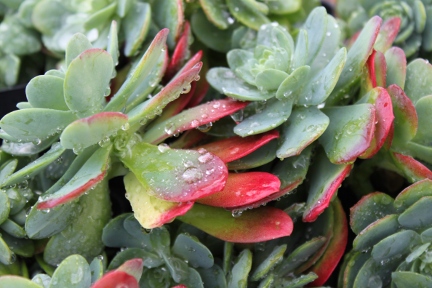
Sedum palmeri
This sedum is native to Mexico, and it does produce yellow, starry flowers, but I love the soft pink blush on the edges of the mature leaves.  It's most at home in a light, well-draining soil with afternoon shade in the summer.  In fact, it would probably be happy with afternoon shade all year long -- a perfect hanging basket or container plant.


It's not altogether hardy here in zone 9A.  If we get the Arctic blast that's forecast for mid-month, I'll bring them in or cover them, especially since these are little baby plants.  Other than that, it's a reliably carefree plant!

Note:  this plant is also known as Sedum palmeri emarginatum.

Tuesday, December 28, 2010

Who's In, Who's Out

Okay, I'll confess.  You may have heard me declaim that I never protect plants in the winter.  And it's true, mostly.  If you're planted in the ground, you'd better be able to stand on your own two feet in my garden, metaphorically speaking. 

However, I realized this weekend (after two hard freezes in a row) that there are some container plants that I do lug into the house each winter.  Fewer and fewer every year, it turns out, because at the moment of truth, there are always some that do not make the cut.  This year, a ratty old mandevilla has been left to freeze to death.  And that Northern Maidenhair fern that moped for a solid year? Abandoned to the bitter north wind.  (In my dark little heart, I believe it served him right!)

The best of the bunch.
But in the interests of truth and justice, I not only take it back my rash statements regarding winter protection, I offer proof of what a pitiful winter gardener I actually am.  The picture above is my south-facing bathroom window.  The light in there is so bright that I have to use the blinds or the clivias would frizzle up and die.  Here's where I have my portulacarias, the two clivias and a hoya.  And now that I see how ratty the hoya looks, I'm almost wishing I had left it on the back porch to fend for itself.

Red philodendron, the vining sort.
Here's the red philodendron, who's only just now recovered from the sunburn he received at the beginning of the spring.  I really should not keep container plants!


Here's the kitchen window -- a motley assortment if ever there was one.   Two paddle plants (Kalanchoe thyrsiflora); a clivia that almost died and is now, slowly, trying to recover; an amaryllis that I haven't gotten around to planting in the garden yet; a cutting from said ratty hoya; a toad lily and a peacock ginger.  My daughter inadvertently dug up the ginger and I never replanted it either.  So here they sit, accusingly.  (Don't you think they look sullen?)


And finally, the window by the front door, a horticultural shame.  The poor croton not only got too cold the other night, it needs water in the worst way.  And I haven't watered it because I can't find my plastic saucers.  You can't find them in stores right now either, so we're at a stalemate.  Sitting next to the croton are two different sorts of pothos ivy.  One is a variegated white and green one but the other is just a plain old variegated yellow one.  I should have left him outside too, especially since there's an old wren nest in that pot.  I think I'd really rather have wrens than that old ivy.

So there!  I do bring provide some winter protection for some plants.  Now that I seem them all sadly arrayed in the house, I wonder why I bother.  Bah humbug to winter!

Thursday, December 23, 2010

Camellia, Queen of the Southern Garden

I have a thing about camellias.  I don't have one in my garden, and I've been doing without since 1990.  Twenty years!  It surprises me to realize that it's been that long.  But 20 years ago, I had just the right camellia growing in just the right place, and I've never been the same since.

Camellia 'Shi Shi Gashira'
Camellias can be fussy customers here.  They seem to prefer a more acidic soil than I've got here in the river bottom.  They like bright shade, but not the north wind.  Not too much water, not too little.  No pruning,  Feeding after blooming, just like azaleas.  They can be susceptible to various fungal diseases like flower blight, and insect pests, like scales.  Moreover, they sometimes drop their flower buds for no apparent reason -- it's their way of complaining that conditions are no longer just right.

If I had never successfully grown camellias, I think I would be over them by now.  But I can't forget those huge old shrubs, over 8 feet tall, growing as if they hadn't a care in the world.  Of course, that garden was 25 miles away from here, and I'm sure the soil is better, and the high shade was preferable to what I've got.  Et cetera, et cetera. 

Meanwhile, I pine away like a jilted lover and long for my camellias.

Thursday, December 9, 2010

Humble Garden, Heavenly Sight

Driving around at 9:00 am, in a very modest neighborhood close to my house, I came across a waterfall of pink flowers that were fairly throwing themselves over a wooden fence.  After a careful look around, I hopped out to take a few pictures, which always makes me a little nervous, to tell the truth.

Podranea ricasoliana
But I love these serendipitous moments.  You'll see some lovely things on garden club tours, but if you keep your eyes open, any neighborhood can surprise you.  Someone in this simple little house carefully planted a flowering vine in just the right spot and was rewarded with this stunning show.  I picture a sweet motherly type in a housecoat, who got her pink trumpet vine from her family in the Valley.  She may have bought it at a nursery, but it's a plant we don't often see for sale.  So I imagine her carrying her little cutting home wrapped in wet paper towels and aluminum foil.  Only she called it "tin foil."

Also known as Pink Trumpet Vine
She planted it never knowing its botanical name, Podranea ricasoliana.  But her own mother told her to plant it in a sunny spot, give it plenty of water in the summer, and plenty of room.  It's a vigorous vine, like its orange cousin, Campsis radicans.  And like the orange trumpet vine, it blooms in late fall, offering the migrating hummingbirds one last sip of nectar before they head south for the winter.

Glorious in the late fall
She was relieved when her pretty vine came roaring back from last winter's freeze.  She needn't have worried -- Podranea is root hardy even a zone north of us.  She'll be enjoying this beautiful vine for years to come, and passing along her own carefully wrapped cuttings.

Cheerful cup-shaped faces
My thanks to this unknown gardener, for providing me with not only a cheery surprise but a story that inspired my gardening heart.

Friday, December 3, 2010

Foliage Friday: Mahonia 'Soft Caress'

Mahonia 'Soft Caress'
I'm excited about this plant.  You're probably familiar with the more traditional mahonias.  Around here, they are very dependable shade plants.  Chinese mahonia get about 5' tall, and, though they have slender leaves, are rather spiny and tough.  Leatherleaf mahonia is even more spiny, having a holly-shaped leaf and a rough-looking, coarse texture.  I always thought I should like them.  They are fairly drought-tolerant and extremely dependable for most people.  But that spiny texture always disagreed with me.  I just could never warm to mahonia.

Mahonia 'Soft Caress'
Until I saw this beautiful Mahonia eurybracteata 'Soft Caress,' whose elegant, bamboo-like leaves are so inviting.  This one was developed by ItSaul Plants, and is more similar to Chinese mahonia.  It's also evergreen, and a little smaller, reaching only about 3 feet tall.  It has yellow flowers, arranged in racemes, but I love it for its delicate leaves.  It seems so much more friendly than other mahonia -- makes you just want to pet it, doesn't it?

Monday, November 29, 2010

Frost Warning? I'm Just Sayin'...

You remember last year how, not only was there frost but SNOW on December 4th?

Cabbages fight it off!
I don't think it'll snow this week, but we've already had a frost at my house, and it looks likely for Tuesday night.  Frost can damage plants even if the air temperature doesn't actually get below freezing.  This always seems like a hard fact to accept here in semi-tropical zone 9A.  But this is the time of year for that sort of thing.  Plants aren't hardened off.  The weather changes rapidly from mild, sunny days to bleak, chilly days.  What to watch out for?  Calm, clear, dry nights.

No ill effects.
The heat absorbed by the earth is released or radiated into the atmosphere at night.  Clouds help keep that layer of heat closer to the surface of the earth, and slow the radiation.  Wind helps mix cold air and warm air, maintaining a bit warmer air than might otherwise occur on still nights.  And humidity slows temperature change.  We notice this most in the summer, when our hot humid nights barely cool down to 80° before it's time to heat up again in the morning.

Amaryllis soft tissue ruined, but plants survived.
Radiation frosts can occur even if the air temperatures remain above freezing.  What's happened?  The surface temperature of the plant has dropped below freezing, even though the air has not, and if sufficient moisture is in the air, ice crystals may form. 

Night photo of frost-bitten tomatoes
The frost last week got the top of the tomato forest, but overall the plants look okay.  I think it's best to leave frost or freeze-damaged foliage on the plant, to provide a bit of protection throughout the winter.  If I pruned back to live, healthy tissue, more of the plant would suffer damage in the next frost.  Yes, it's ugly. After I harvest the tomatoes, I'll pull them out.  But landscape plants are best left alone, unpruned, until March.  You don't want to encourage new growth midwinter, either.

We like to get all excited about winter here, because we get so little of it!  I imagine those zone 4 and 5 gardeners are laughing at us right now, worrying about our little frosts.  That's okay -- I chuckle to myself when they complain about humidity!

Saturday, November 27, 2010

Charisma

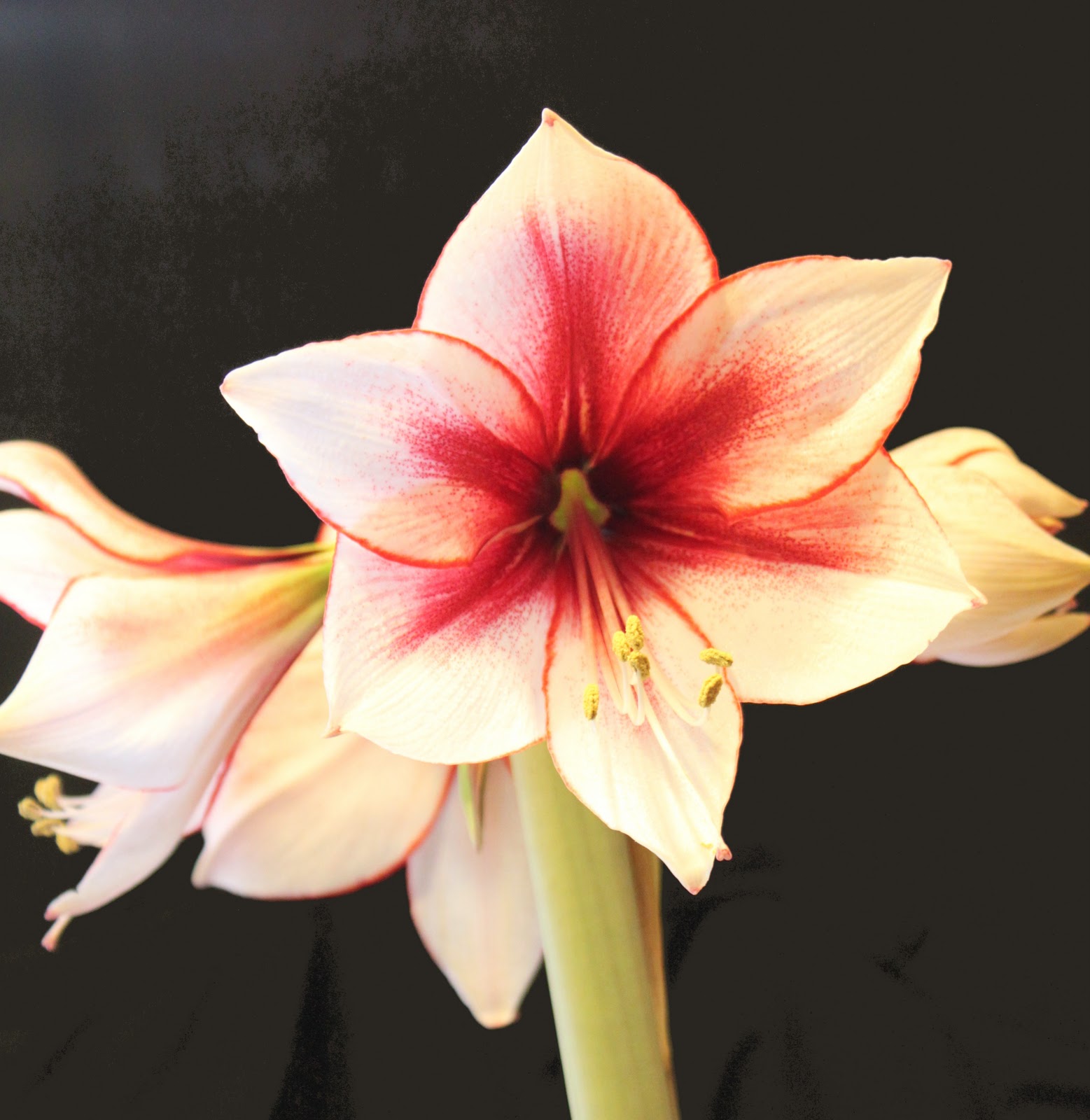
That's the name of this beautiful amaryllis.  You may remember that I heroically limited myself to one amaryllis bulb this year at the Garden Club of Houston's Bulb and Plant Mart.  I'm in the habit of forcing the amaryllis bulbs for the holiday season, then planting them in the garden to bloom forever more.  This usually results in blooms for Thanksgiving (if I've chosen a South African variety) or Christmas (if I've chosen a Dutch variety).  'Charisma,' as it turns out, is a Dutch amaryllis, but bloomed just in time for the Thanksgiving holiday -- and I was grateful. 

Amaryllis 'Charisma'
Truthfully, I never consider whether the bulbs are European or South African, though.  I look for a color that I don't already  have, and, to some degree, for height.  I like shorter, fatter stems that might not have to be staked once they are blooming on their own in the garden.

Growing amaryllis is as tradition in my family that goes back a century or more.  Some of the bulbs in my garden were handed down from my great-grandmother.  These long-lived plants are easy to propagate by division and also set seed, so once established, an amaryllis bed can carry on for a long, long time.  So whenever an amaryllis gardener in my family has to move, we dig up the bulbs before the house ever goes on the market and move them to a safe harbor.  Then we plant them in a new home, keeping the circle unbroken, if you will.

Amaryllis 'Charisma,' right before fully open
I have probably 150 or more individual amaryllis plants in my backyard, which is entirely too many.  I'm breaking all the garden design rules for texture and leaf shape.  I have one: long, sword-shaped foliage, which indicates a severe case of bulb mania.  I sometimes think I should try to restrain myself, maybe plant something else, maybe give away some of the amaryllis.  After all, they only bloom once a year and it would be nice to have something showy in other seasons, too.  But when all is said and done, I can't resist.  This is the first year, in fact, that I've been able to stop at just one!

Oh, well.  When I am all covered up in amaryllis leaves, just put a plaque on the front door and we'll call it a living memorial to my generations of gardening women forebears.

Monday, November 22, 2010

My Favorite Fall Flower: Calendula

Keeps going and going!
No, not chrysanthemum. Calendula, or pot marigold. These cool-weather favorites are just the right cheery shades for fall. For me, they're untroubled by disease or insects and tend to reseed generously. The new seedlings don't often make it through our hot seasons, but I've got to give them credit for trying.

Stems are long enough for cutting flowers.
Calendulas are very tough flowers and really only need protection during severe (for us!) cold weather.  To tell the truth, I don't cover mine at all.  Most years, they keep on blooming right up through June before they start to look raggedy and spent.  If I were conscientious, I'd collect seed. But I'm not.  I buy them in the fall at the garden center and pop them in.  

Tend to sprawl -- not for the regimented gardener!
Calendulas perform best for me in full sun, although these seem pretty happy in morning sun.  They tend to spread out or sprawl, so I plant them about 12" apart.  They rebloom best if you deadhead them, but I never do.  You saw those dianthus back on Bloom Day:  they went into complete horticultural shock because I deadheaded them for their photo opportunity.  Never happened to them before and probably never will again!

Fencing keeps out garden predator dogs!
All parts of the calendula are edible, and I grow mine in the vegetable garden.  You can sprinkle the petals in salads or use them to give a yellow tint to icings, rice, egg dishes or sauces.  The leaves taste bitter to me, but you can eat them if you want to!

Triangle Flashback, I think...
Look for varieties like Art Shades, which are double or semi-double; Bon Bon, a fully double variety with a little dark center; Neon, whose orange petal-tips are edged with burgundy; and Triangle Flashback, my favorite, with a large, showy dark center.  Here's a hint:  calendulas look far better at home in your flowerbed than they sometimes do at the nursery.  Don't be afraid to buy them if they're full, lush and green but aren't blooming yet.  They will!  And they'll last and last and last.

Thanksgiving color scheme

Friday, November 19, 2010

Foliage Friday: Dianella tasmanica variegata

This is one of my favorite foliage plants.  Don't be fooled: the plant label will mention a flower, but it's insignificant.  The main attraction is the bright, clear variegated pattern of the leaves.  You may read that this plant can take full sun, but I think it performs better in morning sun or light shade. The variegated one seems especially sensitive to full sun and may suffer from burning on the margins if left to bake in the August heat.

See the tiny flowers?
Dianella tasmanica is more often called Flax Lily and is almost always evergreen here in zone 9A.  If you want to avoid freezer burn, cover the newly planted ones on frosty nights.  This species of Dianella gets about 2 feet tall and is getting more and more popular as a landscape plant.  You should be able to find it at most area nurseries.  Start with a rather larger plant, because it tends to grow rather slowly.  Dianella is a tough little plant, though, and should be relatively trouble-free once established.

Wonderful massed as a groundcover.
Some sources claim that Dianella is named after Diana, the Roman goddess of nature and hunting.  Maybe so!

Tuesday, November 2, 2010

The Season Winds Down

Summer, that is.  November 1 as I write this, the nominal end of summer, if not the hurricane season.  And the garden looks like its holding on to the last few summer blooms, or resting up for the fall season.  Here's one last crinum that surprised me yesterday.  I thought they were all finished.

Summer's Last Crinum (probably!)
And the butterfly gingers continue to bloom, but slower now.  The fragrance is powerful, and reminiscent of gardenias.  If I were a hawk moth, I'd be there every night!

Wildly fragrant hedychium
Here are a few chrysanthemums, pale shadows of their cousins in garden centers now.  These are about four years old, and planted in an east-facing flowerbed.  When I planted them, they were dark lavender.  Now they've reverted to their true nature.  Which is sweet, small and not really worth it.  They are the last mums I ever bought.  I realized that I was constitutionally incapable of discarding them while there was the slightest evidence of life.  Henceforth, I'm cursed with these weak sisters who really should be removed and other, sturdier plants put in.  Live and learn.

Mums.  Ehh!
The bougainvilleas seem much happier, though, now that the hellish heat of summer has broken.  Even though we think of them as tropical bloomers, mine actually do much better in the spring and fall, when they can rest in the cooler, nighttime temperatures.  I can't quite capture the color of these flowers -- they are quite an unearthly shade of purple.  Mixed with that glowing morning glory of last week, they have an almost chemical aura.

Bougainvillea.  Intense!
And this little ornamental pepper, like the famous bunny, keeps going and going.  It either survived last winter or reseeded itself where it always does.  I like it for its perky colors and for the fact that I don't have to pick or pickle them!

Ornamental peppers.  No canning required!
 And finally, here is Valentine, who's also pricking up her ears a bit.  She likes the cooler temperatures too, but she's also celebrating the fact that I moved her to a sunnier location.  She's had a sunny fall, with no rain to speak of.  So, no blackspot!

Valentine.  Redder than Knockout and just as healthy!

Friday, October 29, 2010

Foliage Friday: Nandina 'Blush Pink'

Years ago, I developed a strong dislike, verging on hatred, for nandina.  People who don't garden are always a little surprised that we can actually hate a plant, but we can and we do.  Every gardener I know has a plant that she secretly (or not so secretly) despises, sometimes for no reason at all.  I'll confess, I hate red annual salvia, like 'Lady in Red,' and also the bronze-leaf wax begonias.  No reason.  Just hate them.

But I had a good reason, long ago, for disliking nandina.  The Chief Engineer and I had just bought our first house together, and I took it into my head to dig out the nandinas in the front and replace them with azaleas.  The house boasted two huge Camellia japonicas, and to my way of thinking, only azaleas would do.  Digging them out nearly killed us.  Eventually, we had to tie one of the rootballs to the truck and pull it out.

However, it's been over 20 years and I'm coming around.  This winter, the nandina were stunning, perhaps because most of our tropicals and semi-tropicals were so badly frozen.  The leaf color was rich and dark green or red and the berries were abundant.  I feel better about nandina now.

Nandina 'Blush Pink'
Here's a nandina that's especially pretty.  'Blush Pink' is a sport of an old nandina favorite, 'Firepower.'  The new growth is almost red and contrasts nicely with the bright lime-green older foliage.  This nandina's on the compact size and should only reach about 3 feet tall.  All nandinas tolerate bright shade and make a nice, evergreen foundation plant for the South.

Note:  some jurisdictions list Nandina, or Heavenly Bamboo, as an invasive species.  Some experts disagree.  They do sucker outward, forming ever-larger clumps.