Pied Beauty

Gerard Manley Hopkins (1844-1889)

Glory be to God for dappled things—
For skies of couple-colour as a brinded cow;
For rose-moles all in stipple upon trout that swim;
Fresh-firecoal chestnut-falls; finches' wings;
Landscape plotted and pieced—fold, fallow, and plough;
And all trades, their gear and tackle and trim.

All things counter, original, spare, strange;
Whatever is fickle, freckled (who knows how?)
With swift, slow; sweet, sour; adazzle, dim;
He fathers-forth whose beauty is past change:

Praise him.

Showing posts with label freeze. Show all posts

Friday, December 31, 2010

Tomato Forest Bids You Farewell

Well, two hard freezes in a row may have been too much for the tomato forest.  After Wednesday's heavy rains washed all the dead and dying leaves off the plants, there really wasn't much left.  Some of the plants in the very back still had bright green leaves and even flowers, but their time is past.  Which is fine, really.  It's almost time to plant spring tomatoes!

Ripening on the dining room table now...
This year, the fall tomatoes produced very well, but just a little too slowly for the weather.  You never can tell:  some years, we don't get a frost until very late, and some years it sneaks up on us.  Most of these tomatoes will ripen on the counter, and the ones that don't we'll eat anyway.

Heavy equipment optional.
Fried green tomatoes isn't just a movie -- they're the easiest things in the world to cook.  Slice them fairly thick, dip them in something like milk, buttermilk or egg, then dredge them in something like cracker crumbs, bread crumbs or cornmeal.  Then fry them up!  I like mine with some sort of sauce.  Marinara sauce is good, but it doesn't seem right to serve tomatoes with tomato sauce.  Try sour cream mixed with a judicious amount of prepared horseradish.  There are probably young people in this very house who would vote for ketchup -- but don't listen to that sort of nonsense.

Cheers, and Happy New Year to you all!

Tuesday, December 28, 2010

Who's In, Who's Out

Okay, I'll confess.  You may have heard me declaim that I never protect plants in the winter.  And it's true, mostly.  If you're planted in the ground, you'd better be able to stand on your own two feet in my garden, metaphorically speaking. 

However, I realized this weekend (after two hard freezes in a row) that there are some container plants that I do lug into the house each winter.  Fewer and fewer every year, it turns out, because at the moment of truth, there are always some that do not make the cut.  This year, a ratty old mandevilla has been left to freeze to death.  And that Northern Maidenhair fern that moped for a solid year? Abandoned to the bitter north wind.  (In my dark little heart, I believe it served him right!)

The best of the bunch.
But in the interests of truth and justice, I not only take it back my rash statements regarding winter protection, I offer proof of what a pitiful winter gardener I actually am.  The picture above is my south-facing bathroom window.  The light in there is so bright that I have to use the blinds or the clivias would frizzle up and die.  Here's where I have my portulacarias, the two clivias and a hoya.  And now that I see how ratty the hoya looks, I'm almost wishing I had left it on the back porch to fend for itself.

Red philodendron, the vining sort.
Here's the red philodendron, who's only just now recovered from the sunburn he received at the beginning of the spring.  I really should not keep container plants!


Here's the kitchen window -- a motley assortment if ever there was one.   Two paddle plants (Kalanchoe thyrsiflora); a clivia that almost died and is now, slowly, trying to recover; an amaryllis that I haven't gotten around to planting in the garden yet; a cutting from said ratty hoya; a toad lily and a peacock ginger.  My daughter inadvertently dug up the ginger and I never replanted it either.  So here they sit, accusingly.  (Don't you think they look sullen?)


And finally, the window by the front door, a horticultural shame.  The poor croton not only got too cold the other night, it needs water in the worst way.  And I haven't watered it because I can't find my plastic saucers.  You can't find them in stores right now either, so we're at a stalemate.  Sitting next to the croton are two different sorts of pothos ivy.  One is a variegated white and green one but the other is just a plain old variegated yellow one.  I should have left him outside too, especially since there's an old wren nest in that pot.  I think I'd really rather have wrens than that old ivy.

So there!  I do bring provide some winter protection for some plants.  Now that I seem them all sadly arrayed in the house, I wonder why I bother.  Bah humbug to winter!

Thursday, December 2, 2010

We Got A Freeze After All

Not a very hard freeze.  It was 30° at the Sugar Land airport when I got up at 5:30 Wednesday morning.  Which means it probably got to 30° in some unprotected parts of my garden too.  And a hard frost! I know it's a problem for gardeners, but I love the sparkle of the first hard frosts.  I took a drive before the frost had melted, but after the bright sun was shining.  Gorgeous!  Our version of winter beauty: bright, clear, dark blue sky (in the summer, the sky bleaches to almost white), golden grasses, sparkly frost, a few yellow leaves.  It's a stark beauty, one you have to get used to.  But I love it.

Ouch!  Tomato forest gets stung again.
In the garden, the tops of the tomato forest burned a bit more.  I don't think the plants will die, and I don't think it will harm the tomatoes.  I'm just waiting for a few to begin to ripen!  I think I'm almost there.  I'm keeping my fingers crossed we don't get a really terrible freeze before that happens.  On the other hand, I didn't cover them.  I'm resigned, either way.

Nasturtiums show only minor damage
The nasturtiums got a bit of a snap, too.  I don't know, really, whether the frost or dehydration got these leaves.  It was very windy Tuesday ahead of the cold front.  Extremely windy!

These are fine.
These too!
And these!
The lettuces don't notice light freezes and frosts, which made me wonder.  Why don't those tender looking leaves suffer in the cold and wind?  All the other plants I have with large leaves dehydrate so badly.  Where did lettuce originate, that it is so deceptively hardy?  I came across several answers: Egypt, Persia, Greece.  All relatively warm places.  So I ask you -- why does lettuce laugh at frost?

Snapdragons look like buttered popcorn!
And here is the reason I like to plant flowers in the vegetable garden.  It means I'm always successful! 

Monday, November 29, 2010

Frost Warning? I'm Just Sayin'...

You remember last year how, not only was there frost but SNOW on December 4th?

Cabbages fight it off!
I don't think it'll snow this week, but we've already had a frost at my house, and it looks likely for Tuesday night.  Frost can damage plants even if the air temperature doesn't actually get below freezing.  This always seems like a hard fact to accept here in semi-tropical zone 9A.  But this is the time of year for that sort of thing.  Plants aren't hardened off.  The weather changes rapidly from mild, sunny days to bleak, chilly days.  What to watch out for?  Calm, clear, dry nights.

No ill effects.
The heat absorbed by the earth is released or radiated into the atmosphere at night.  Clouds help keep that layer of heat closer to the surface of the earth, and slow the radiation.  Wind helps mix cold air and warm air, maintaining a bit warmer air than might otherwise occur on still nights.  And humidity slows temperature change.  We notice this most in the summer, when our hot humid nights barely cool down to 80° before it's time to heat up again in the morning.

Amaryllis soft tissue ruined, but plants survived.
Radiation frosts can occur even if the air temperatures remain above freezing.  What's happened?  The surface temperature of the plant has dropped below freezing, even though the air has not, and if sufficient moisture is in the air, ice crystals may form. 

Night photo of frost-bitten tomatoes
The frost last week got the top of the tomato forest, but overall the plants look okay.  I think it's best to leave frost or freeze-damaged foliage on the plant, to provide a bit of protection throughout the winter.  If I pruned back to live, healthy tissue, more of the plant would suffer damage in the next frost.  Yes, it's ugly. After I harvest the tomatoes, I'll pull them out.  But landscape plants are best left alone, unpruned, until March.  You don't want to encourage new growth midwinter, either.

We like to get all excited about winter here, because we get so little of it!  I imagine those zone 4 and 5 gardeners are laughing at us right now, worrying about our little frosts.  That's okay -- I chuckle to myself when they complain about humidity!

Monday, July 5, 2010

Palm Trees: A Surprising Recovery


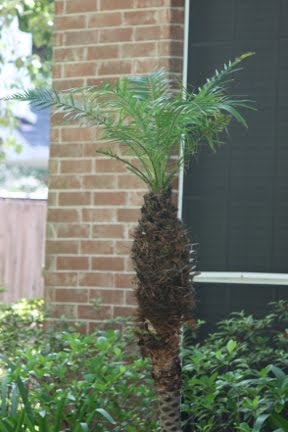
After the freezes in December 2009 and January 2010, many of us mourned the loss of palm trees all over the city.  The fan palms seemed to weather the cold, but the finer-textured palms, like Queen Palms and Pygmy Date Palms, seemed like goners.  They lost their foliage entirely and for months remained leafless and sad.


But now that the weather is hot, day and night, even some of these tropical palm trees have begun to leave out, much to my surprise and relief.  Some newly planted palms certainly died in the cold, but many of the well-established ones seem to be recovering.  Depending on the damage they sustained, it's still possible for even green palms to die this summer, especially if they are stressed by drought.  But I am much encouraged by the sight of all those green fronds!

(On the left: February 7.  On the right: July 4)

Some palms didn't die of exposure, though:  they died from improper pruning.  The "heart" of a palm, the growing tip or meristem, is at the top of the trunk, where the fronds emerge.  Some people were a tad aggressive when removing brown fronds -- they cut the palm too low and inadvertently removed the palm's heart.  These trees will not recover.  Palms typically cannot regenerate the heart and have only limited ability to regenerate tissue along the trunk.

This pygmy date palm is regrowing from the roots because the top was so badly damaged.

Next winter, protect this growing tip by wrapping it or tying the foliage up and around the top of the trunk.  Make sure that the palm isn't under any environmental stress going into winter by providing sufficient water and fertilizer designed specifically for palm trees.

This queen palm was planted in the summer of 2009 and not properly watered.  It was young and stressed when the cold weather blew in and it doesn't look like it's going to make it.

Did you lose your tropical palms (or give up on them too soon?)  Download a list of palms that are suitable for growing here, in zone 9A.

Monday, May 3, 2010

Zoo Tour

Saturday I had the pleasure of a guided tour of the Houston Zoo, led by Manager of Horticulture Joe Williams.  I love visiting other people's gardens, and this tour was exactly that, albeit on a much grander scale.  Mr. Williams talked about winter protection, managing invasive plants, struggling to provide a beautiful environment for special events, wondering whether or not prized specimens would pull through the freeze.  Just like you do.  Just like I do.  That was refreshing, and reassuring, in a way.  And he also shared the particular problems he and his team encounter, in dealing with the public.  It never occurred to me that visitors would not only pluck leaves and flowers (I knew they did that!) but would carry them for hundreds of yards before finally throwing them into an animal exhibit!  I figured people would walk on the grass, but I didn't quite understand that they walk right through planting areas, if they aren't sufficiently thorny (the beds, not the visitors).  I'm glad, really, that I don't have to deal with that.  I wouldn't have the patience.  But I envy Mr. Williams the grand scale of his garden.  What a treat it must be!  I have nine trees.  His are uncountable.  I have one beautiful Baldcypress that I treasure.  He has many, and dwarf Baldcypress and Pond Cypress and Montezuma besides.  I was jealous of those trees for the remainder of the day.

I was happy to learn that the hard freeze Houston endured did not devastate the gardens at the Zoo.  Mr.  Williams estimates that they only lost 5 of the over 100 Pygmy Date Palms (Phoenix roebelenii) that are planted.  There is life yet in the Silk Floss Tree (Chorisia speciosa), the Royal Poinciana (Delonix regia) and most of the tropical palms.  The African bauhinia (Bauhinia galpinii) and the Hummingbird Bush (Hamelia patens) are coming back from the roots and the flowering fruit trees were in their glory.  All over the zoo, the pomegranates (Punica granatum) were blooming, along with the native flowering deciduous trees.

I asked Mr. Williams how he protected his plants.  He said they apply compost from Nature's Way twice a year.  They also benefit from a heat-island effect, surrounded by the Texas Medical Center and the smaller buildings of the zoo.  Their tree canopy also provides protection from night-time frosts and helps slow heat  loss.  He did not use copper fungicides on his palm trees, which is recommended by some experts immediately after a freeze that may damage a palm's heart.  There could be an issue with copper toxicity for the animals.  Instead he used a drench of hydrogen peroxide to help ward off attacks by opportunistic fungi.

I took many pictures on my tour, far too many to include here.  Visit my Flickr page for the entire set.  I've tried to annotate them, providing common and botanical names of all the plants I photographed.  I hope you all can join me on the next tour!